


Explore the World of 1/35 Scale Tanks: Key Features, Airbrushing Techniques, and the Best Retailers for Scale Model Kits
Why 1/35 Scale Tanks Matter
Tank modeling has something special that can really hook you from the very beginning. Its appeal isn’t just about assembling a lot of parts that bring detail and life to a model, or simply following assembly instructions. It’s about being able to represent, as realistically as possible, a real object that has a story behind it, that served a real purpose in a real historical context, and that is also an iconic machine with features that make it stand out. But it doesn’t stop there. The model itself, starting from all of that, demands that you’re able to translate everything into the build so that, in the end, it actually looks believable.
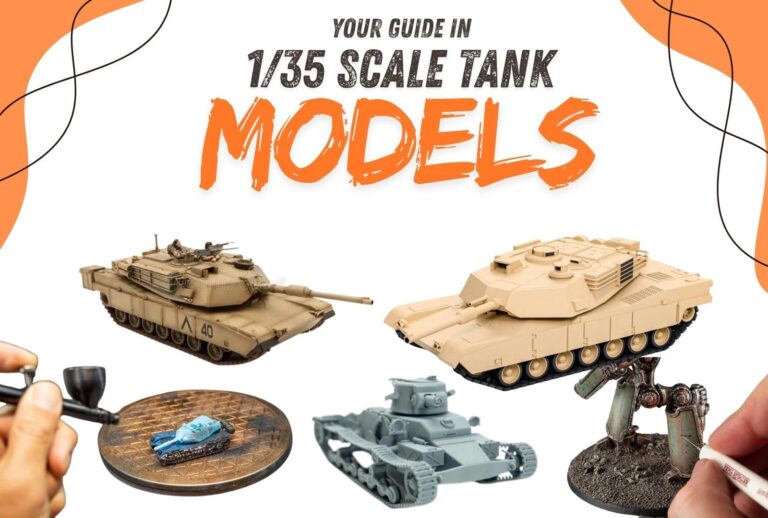
As you can see, throughout that process the technical side of assembly blends naturally with your creative and artistic side, where painting, weathering, and the visual context you manage to achieve end up being just as important as how well the parts fit together.
Within scale modeling, 1/35 occupies a very particular place. It’s not simply one of the most commonly used scales for armored vehicles, but one that almost immediately shapes how each project is approached. The relatively “large” size of these models invites you to slow down, to plan how the build will come together (yes… even though kits include instructions like any other model, carefully reviewing them often reveals that in some cases it makes sense to move certain steps forward or delay others, or even spot errors that appear quite frequently in those instructions), how it will be painted, and how far you want to push the level of detail.
It’s a scale that isn’t awkward to handle at all, but also doesn’t fall short when it comes to adding nuances, corrections, or improvements. There’s almost always room to add or modify things to make the model feel more realistic, or simply to include details the kit doesn’t provide.
That balance is a big part of its appeal. The scale allows you to apply more elaborate camouflage schemes, experiment with weathering without fear of losing it, and add details that are actually noticeable at a glance. At the same time, even though we’re talking about relatively large models (especially compared to 1/72), once finished they’re still compact enough to fit nicely in a display case, on a simple base, or even as part of a diorama. That matters a lot, especially if you’re working with limited space and want to display several finished builds.
So when someone talks about 1/35 scale tanks, they’re usually not just referring to a popular scale choice. They’re talking about a scale that directly influences how the entire project is planned, from assembly to the final presentation. Once you internalize that idea, it becomes much easier to understand why so many modelers keep coming back to 1/35, and why over time it has become a true reference point in armored vehicle modeling.
What Is a 1/35 Scale Tank Model?
When a model is in 1/35 scale, it simply means the real vehicle is thirty-five times larger than the model sitting on your workbench. That might sound technical, but in practical terms what really matters is that this size makes it easy to recognize shapes and volumes without the model becoming uncomfortable to work on, handle, or display.
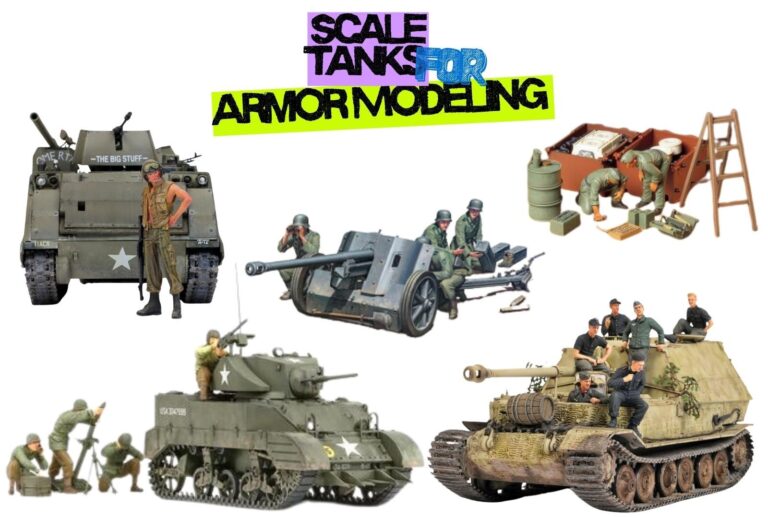
Although 1/35 is almost automatically associated with tanks or armored vehicles, the scale goes well beyond that. Some brands have produced aircraft and helicopters in 1/35, and there’s also a massive world of figures (plastic, resin, and more recently 3D-printed) specifically designed to accompany these models. Those figures make it possible to add context, tell small stories, and reinforce the sense of real scale by showing just how large the vehicle is next to a human figure.
As mentioned before, the final size of the model directly affects the building experience. Parts aren’t tiny or excessively fragile like they often are in smaller scales, which makes handling and fitting much easier. At the same time, there’s enough room for clear surface detail, structural elements, and subdivisions to really stand out. This results in kits that can include many parts sometimes even with working or movable elements, which adds realism and opens up more display possibilities without turning the build into a frustrating experience right from the start.
Because of all this, 1/35 isn’t perceived simply as a number or a ratio. For many modelers, it becomes a standard that opens the door to more complete projects than just a single vehicle sitting on a table.
Why 1/35 Became the Standard for Armor Modeling
Based on everything discussed so far, it’s easy to see that the consolidation of 1/35 scale wasn’t the result of a single decision or a passing trend. It was a gradual process that took shape as armored vehicles gained more and more importance within the hobby. Over time, many modelers realized that working in slightly larger scales allowed for richer visual and structural results without sacrificing comfort during the build.
This scale found its natural place with armored vehicles because of their compact, block-like geometry, which made them relatively easy to store and display even as size increased. With 1/35, modelers gained presence, surface area, and volume without constantly struggling with display space-something that does tend to happen with longer or more delicate subjects like aircraft.
That balance had a clear impact on kit evolution. Manufacturers began producing models with more parts, more assembly options, and greater structural depth, something far more limited in smaller scales.
At the same time, the long-standing interest in World War II vehicles played a major role. The incredible variety of designs, configurations, and camouflage schemes from that period created demand for models capable of representing those differences clearly. The 1/35 scale met that demand well and gradually became a common reference for depicting armored vehicles from different eras and countries.
In the end, it was this combination of manageable size, high detail potential, and versatility that firmly established 1/35 as the standard in armor modeling. Not because it’s the only valid option, but because it provides a solid and flexible foundation for building projects that are more expressive, complete, and satisfying from a practical standpoint.
What Modelers Look for in a 1/35 Tank Kit
When a modeler chooses their next 1/35 scale tank, the decision almost never starts with a rigid checklist. In reality, it’s a much more intuitive and personal process shaped by experience, personal taste, and the kind of project they want to build. Before worrying about part count or technical complexity, the first thing that usually matters is much simpler: does the vehicle catch your eye, and does it genuinely make you want to invest time and effort into it?
Because of that, the visual design of the vehicle and its context play a big role in the initial choice. Many modelers are drawn to unusual vehicles, rare variants, or camouflage schemes that stand out from the usual options (although sometimes it’s simply a matter of liking a particular vehicle and its different visual or structural variations). In any case, it always comes down to personal preference. It’s very common for a tank that’s been built countless times or finished in a very uniform scheme to feel less interesting than one with more complex shapes, richer color combinations, or a less repetitive background. At that point, the kit stops being just a model and becomes the starting point for a project driven by curiosity and motivation.
Once that first connection is there, other factors start to matter more consciously. These include overall mold quality, surface definition, and part cleanliness. Kits produced with more modern tooling tend to give an immediate sense that the build will be smooth and enjoyable,
allowing you to focus on the process instead of fixing basic issues from the start.
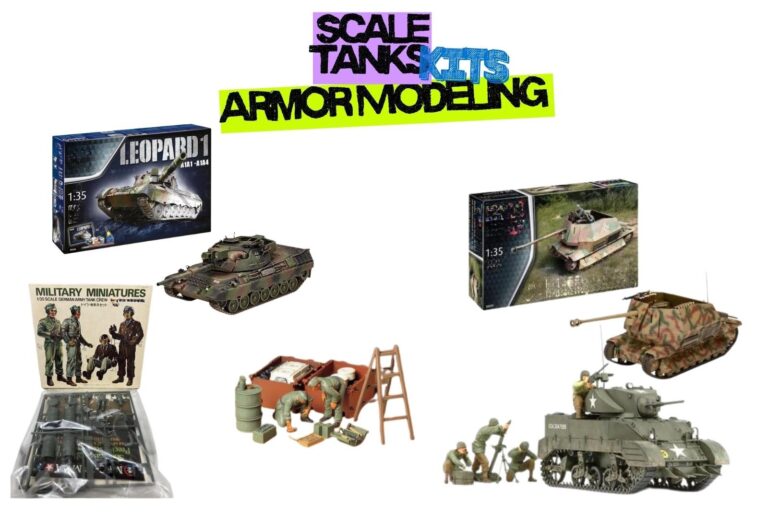
Certain elements that expand what you can do with the project also come into play. For example, the type of tracks included can influence both the final look of the model and how you approach the build. The same happens when a kit offers multiple versions of the vehicle, alternative assembly options, or small extras that allow for customization without turning the build into an unnecessary challenge right away.
In the end, none of this is evaluated in isolation or in a fixed order. Over time, each modeler develops their own criteria, combining intuition, experience, and expectations. What truly makes a 1/35 kit appealing isn’t that it checks every “correct” box, but that it has enough potential to become a project that motivates you, challenges you just enough, and lets you explore different sides of the hobby, from assembly to painting and weathering.
Common Challenges When Building 1/35 Tank Models
When you dive into a 1/35 scale tank, even with experience, it’s very normal to run into moments that require more patience than expected. Not because you’re doing something wrong or because the kit is bad, but because these models pack in a lot of structural parts that all need to work together precisely. Part of the appeal of 1/35 is exactly that complexity, which forces you to slow down and accept that not everything will fit perfectly on the first try.
One area where this shows up most often is in general fit. Even though many modern kits are very well engineered, it’s still common to encounter tight fits, delicate parts, or sections that don’t align as cleanly as expected. Instructions themselves can sometimes be unclear, omit where a part should be glued, include incorrect numbering, or fail to show the correct orientation. It’s also not unusual to realize that the suggested assembly order isn’t the most practical one, and that moving certain steps earlier or later makes the build easier and safer.
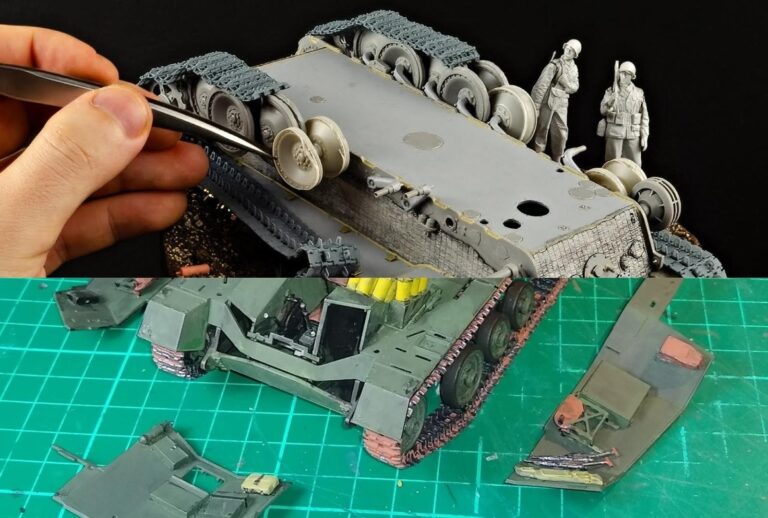
The running gear is another classic challenge. Suspensions, arms, and wheels all need to be properly aligned so the vehicle “sits” naturally once finished. On a tank, a lot of the realism comes from how it rests on the ground. If something is off here, the model can look odd even if everything else is well built. That’s why this stage usually benefits from taking your time and checking the overall look before committing.
General alignment of the hull and turret also plays a big role in the final result. Surfaces that should look straight or parallel can lose balance if a section is rushed or assembled without clear visual references. The size of 1/35 makes these issues more noticeable, but it also works in your favor by making them easier to spot and fix early, as long as you stay attentive.
All of this is simply part of building armored vehicles in this scale. These aren’t exceptional problems or signs that something is going wrong; they’re normal situations when working with highly detailed models. Being aware of these critical points helps set more realistic expectations and makes the whole process far more manageable.
Tank Tracks: The Detail That Changes Everything
As hinted in the previous section, within 1/35 tank modeling, tracks are one of the elements that have the biggest impact on the final look of a vehicle. They’re always there, taking up a large part of the visual mass, and even if you don’t think about them at first, they end up defining how the model feels once it’s finished. You can have clean assembly and solid paintwork, but if the tracks don’t match the rest of the build, something feels off almost immediately.
That’s because tracks define the vehicle’s relationship with the ground, even when the model is sitting directly on a table. Sag, tension, and the way they wrap around wheels and rollers visually communicate weight and use. In 1/35, tracks that are too stiff or unnaturally shaped stand out right away, while well-executed tracks add realism even to simpler projects. This visual influence is closely tied to the building experience, since tracks often set the pace of the entire project and really test a modeler’s patience.
Vinyl tracks, which were common in many kits for years, are often the entry point for many builders. They’re quick to install and don’t require much effort, but in real use they tend to behave rigidly and offer very little control over their final shape. Painting and weathering them isn’t particularly enjoyable either, so while they do the job, they don’t always fit projects aiming for a more expressive finish.
Link-and-length tracks feel like a well-balanced middle ground. By combining long sections with individual links, they let you shape the track without assembling everything piece by piece. In practice, they offer reasonable visual control without becoming an endless task, and they usually adapt better to the running gear than simpler options. For many builders, they strike a good balance between effort and result.
Individual-link tracks (the ones that actually articulate thanks to pins, not those that must be glued one by one), whether metal, plastic, or resin, take the experience a step further. Each link contributes to the whole, allowing precise control over sag and tension. Assembly can be slow and repetitive, the kind of work that forces you to take your time, but it also gives you full control over the final look.
Metal tracks, in particular, offer a very different experience from the start. Their own weight creates natural sag with minimal effort, and their durability makes handling during painting and weathering much easier. In practice, they feel solid, and once installed they deliver a convincing look that many people immediately associate with high realism.
Rather than searching for a single “best” type of track, working with tracks in 1/35 is really about understanding how each option behaves and what kind of building experience it offers. That choice affects both the process and the final result, and often becomes one of the defining elements of the finished model.
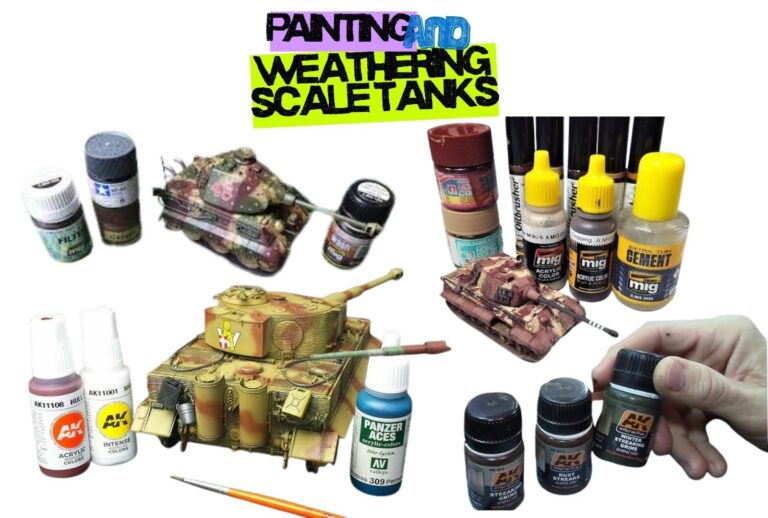
Painting and Weathering in 1/35 Scale
Among scale models, 1/35 has a very special relationship with painting and weathering, mainly because it provides enough space to work in layers without the result feeling exaggerated. Large surfaces allow you to build color gradually, introduce tonal variation, and let effects accumulate naturally. In smaller scales, many of these choices end up being too subtle or almost invisible; in 1/35, each tonal shift has room to breathe and contribute to the overall look.
This is especially noticeable in camouflage. Complex schemes really shine at this scale, not just because of the model’s size, but because every panel, rivet, and change of plane can carry subtle variations that break monotony and add depth. The model stops feeling like a flat surface and starts behaving like a real object, with volumes that react differently to light, dust, and wear.
That freedom also demands restraint. 1/35 allows a lot, but not everything works automatically, and this is where real-world references become essential. Looking at photos of vehicles in service quickly shows that wear isn’t uniform or decorative, but driven by use, environment, and
time. At this scale, it’s possible to recreate that without oversimplifying it, achieving a believable look where dirt, chipping, and color variation feel integrated rather than forced.
Because of that, the final result depends less on how many effects you apply and more on how well they work together. At this point, painting stops being an isolated step and becomes a continuous process that goes hand in hand with assembly and defines the vehicle’s character.
The Role of Airbrushing in 1/35 Tank Modeling
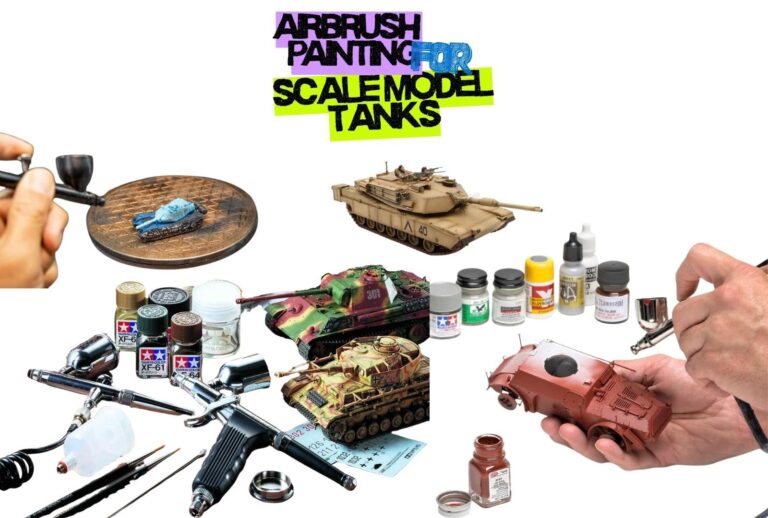
Within that context, airbrushing fits very naturally into 1/35 tank modeling because it responds well to the scale’s real needs. Large surfaces make it ideal for smooth transitions, color modulation, and subtle tonal changes that break uniformity without sacrificing control. In this scale, the airbrush becomes a tool that truly brings these models to life.
Although it’s used throughout the painting process, the airbrush really shines when applying complex or multi-color camouflage schemes, since it helps blend successive layers without the model feeling fragmented (and not all camouflage schemes have hard edges). It’s also extremely useful during weathering, allowing for glazes, soft shadows, and localized variations that blend naturally into the base paint.
Choosing a Brand: What Works for Different Skill Levels
When talking about brands in 1/35 tank modeling, it’s important to clarify one thing from the start: not every brand is aimed at the same type of modeler or the same stage in the hobby. That doesn’t mean some are better than others. It simply means each brand tends to fit different expectations, experience levels, and ways of enjoying the process.
Some brands have built their reputation around accessible kits with good engineering and generally smooth builds. These are often ideal for beginners or for anyone who wants to enjoy the build without every step turning into a technical challenge. The value here lies in being able to move forward confidently, understand how a 1/35 armored vehicle is structured, and gain experience without constant frustration.
Other brands target a different audience. Their kits often include a very high part count, multiple build options, and sometimes aftermarket-style details that add realism but also demand more confidence and skill during assembly. In these cases, enjoyment doesn’t come only from finishing the model, but from planning, dry-fitting, correcting, and solving small challenges along the way. These kits tend to attract modelers who already have some experience and are looking for more than a straightforward build.
Between those extremes are brands that aim for balance, offering modern kits with good detail and excellent fit without turning every project into a test of patience. These options are often appreciated by intermediate builders or by those who alternate between relaxed projects and more demanding ones, depending on time and motivation.
In any case, a brand shouldn’t be evaluated in isolation. The vehicle itself, its configuration, historical period, and the kind of project you have in mind matter just as much as the name on the box. A single modeler can enjoy very different brands depending on the goal of each build, and that flexibility is a natural part of the hobby. Understanding this helps you make more thoughtful choices and avoid unnecessary comparisons, keeping the focus where it belongs: choosing a kit that fits the experience you want from that specific project.
Where to Buy 1/35 Scale Tank Kits?
Finding the perfect 1/35 scale tank kit involves selecting a trusted supplier. Fortunately, there are many online stores, as well as local hobby shops, that specialize in model kits. Below are some reliable sources for purchasing these kits:
1. Hobby Lobby
Hobby Lobby is a well-known craft store with a broad selection of model kits, including 1/35 scale tanks. Their prices are competitive, and they frequently offer discounts.
2. Amazon
Amazon provides a wide variety of 1/35 scale tank kits from different brands. It’s a convenient place for ordering with reliable shipping options and customer reviews to guide your purchase.
3. Squadron
Squadron is a specialist online store that focuses on modeling kits and supplies. They offer a comprehensive selection of 1/35 scale tank kits, including rare and limited-edition models.
4. HobbyKing
HobbyKing is known for its vast range of hobby supplies, including model tanks. Their online store offers competitive pricing and international shipping options, making them a go-to for hobbyists worldwide.
5. SprayGunner
SprayGunner is a trusted online retailer specialized in airbrush supplies, paints, compressors, and hobby tools tailored for scale modeling, miniatures, and creative projects. Their inventory includes curated tools and equipment that support both 1/35 scale tank modeling and airbrush painting techniques, from precision airbrush kits to paints and hobby accessories designed for modelers of all levels. SprayGunner is recognized for its expertise in airbrush painting, offering not just products but also support for hobbyists, and they even host friendly to professional‑level contests and community events that help users refine their skills and showcase their work.
Conclusion
The 1/35 scale has remained relevant for decades because it offers a very fertile ground for growth in armored vehicle modeling. It supports modelers from their first projects through more advanced stages, adapting to different levels of ambition and depth while remaining approachable. Rather than being a goal in itself, it works as a space where skills are learned, ideas are tested, and personal criteria are refined over time.
Along that path, the process often matters more than absolute perfection. Every model built leaves something behind a new technique, a lesson learned, or simply the satisfaction of spending time on something that truly matters to you. That constant evolution, shaped by practice and observation, is one of the greatest strengths of the hobby and one of the main reasons so many modelers continue to find 1/35 a scale worth exploring again and again.




No comments