

For most of my life, creativity felt like a pursuit — something to be chased, coaxed, and occasionally wrestled into existence. I* worked for years as a commercials filmmaker, shaping stories frame by frame, always searching for that elusive balance between vision and execution. But it wasn’t until much later, when I built a daily meditation practice, that I learned creativity has another setting entirely: one in which ideas are not chased but received.
Meditation quietened the noise that had always crowded my inner landscape. With time, I began to notice a distinctive pattern: in the stillness after meditation, images would arise. Not polished
concepts or storyboards, but brief flashes — half-formed memories, symbolic shapes, the texture of a feeling rather than the feeling itself. These fragments felt like visitors from a deeper layer of mind, not invented but uncovered.
Years later, when AI art tools arrived, those fragments finally had a place to land. Today, my creative practice is driven by an unexpected partnership: meditation, memory, and machine learning working together in a way I never could have predicted. AI didn’t replace creativity — it expanded the space in which it could unfold. I could finally become a digital narrative artist. The Inner Archive Meditation, for me, has always been an act of opening. You sit, you breathe, and gradually you drift below the surface noise into something quieter — a landscape shaped by memory, imagination, and something older than both. It’s a place that doesn’t often speak unless invited. In this meditative quiet, I discovered what I now think of as my inner archive. It’s a shifting, dreamlike collection of emotional textures, forgotten moments, childhood rooms, faces that appear only in imagination, and strange symbolic elements that would never belong to waking life — masked figures, half-lit alleyways, floating objects, processions, silhouettes.
Before AI, these flashes were often impossible to translate into artwork. They were too ephemeral, too fluid. I could write them down, but I couldn’t give them form. AI changed that not by making art “easy,” but by giving form to visual intuition. Suddenly my subconscious had a tool that could respond to it.
Meditation as the Creative Spark
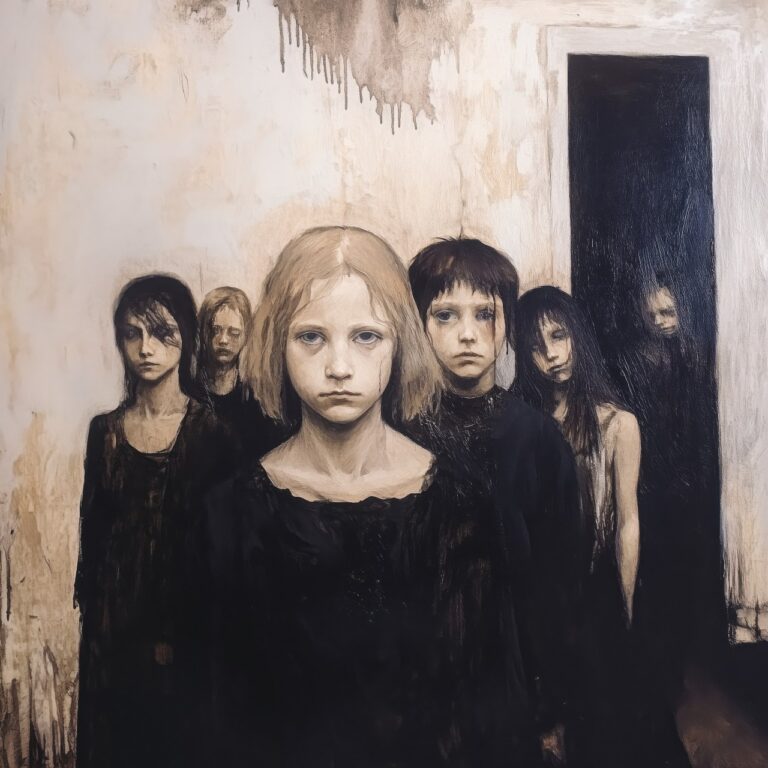
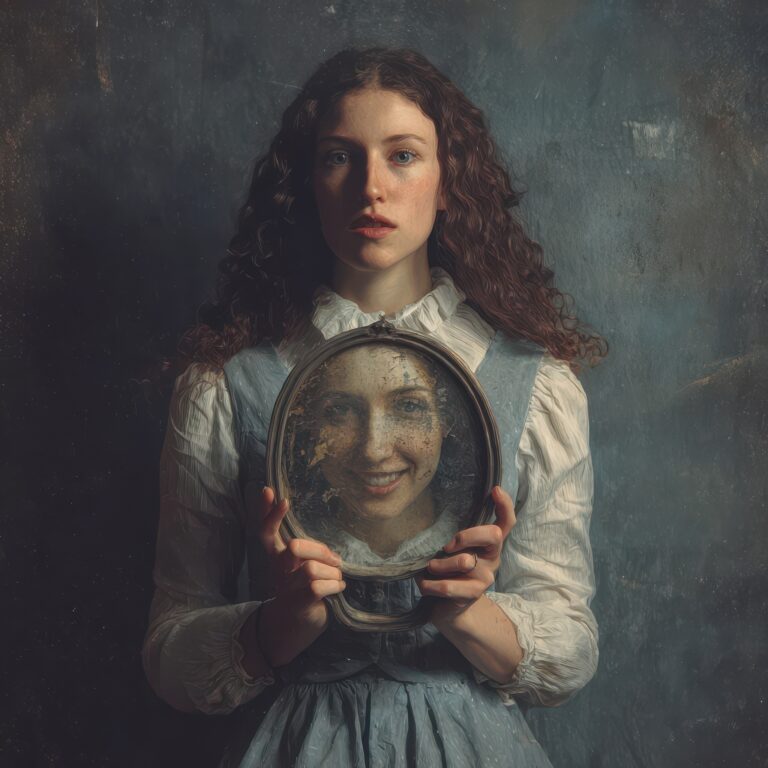
There’s a misconception that meditation empties the mind. In truth, it clarifies it. After the mental debris settles, what’s left is insight: small, sharp, and often surprising. Some days an entire artwork begins with a single sentence that arises during meditation — a phrase such as “the child who remembers too much” or “the silence they inherit.” Other days a colour appears — a certain blue that feels like memory, or a red that carries the weight of ritual and danger. Occasionally an image arrives nearly whole: a girl standing in a ruin with paper birds scattering behind her; a boy looking into a mirror that shows not a reflection but an older self; a procession of masked children walking toward an unseen horizon. These meditative fragments become the seeds of my narrative art series — particularly those exploring memory, identity, false recollection, and the strange emotional truths that lie beneath conscious awareness.
When the Machine Enters the Story
Once a meditative insight appears, I begin working with AI not as a tool that “does the art,” but as a collaborator. My prompts rarely begin with physical description; they begin with feeling.
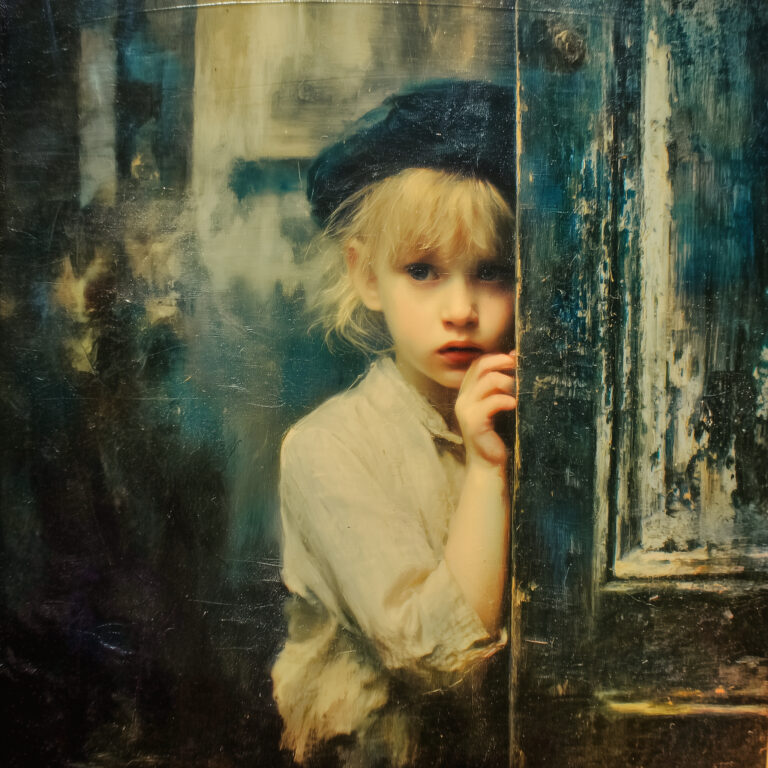
Something like: “A child who cannot tell whether the memory is real. Soft red light. A sense of ritual. A doorway to the past that may be imagined.” AI responds with interpretations — sometimes wild, sometimes uncanny, sometimes unexpectedly profound. These images are never the final artwork. They are stepping stones. I refine, redirect, discard, iterate, and sometimes dismantle the image entirely before rebuilding it in Photoshop. I adjust colour, composition, texture. I remove, repaint, reimagine. What AI gives me is a mirror — but a strange one. It reflects not what I see, but what I sense. It becomes a kind of memory machine, capable of visualising the subconscious material stirred by meditation.
People often assume AI removes the artist from the equation. My experience has been the opposite: it forces me to be more present, more intentional, more emotionally attuned to the work. AI
generates possibilities, but the artist chooses which possibilities hold truth.
Memory, Fiction, and the Self
A recurring theme in my work is the slipperiness of memory. Meditation often reveals how unreliable our recollections are — how a remembered childhood moment changes shape each time
we visit it, or how imagined scenes can take on the weight of lived experience. AI mirrors this beautifully. It produces images that feel like memories, yet they are entirely
fictional. They evoke nostalgia for lives we may never have lived. They blur the line between inner truth and outer fabrication. This tension — between real memory and invented memory — is where much of my narrative art resides. Meditation opens the door to these ghost-memories. AI gives them form. Art lets them speak.
Ethics, Doubts, and the Artist’s Hand
Any artist using AI faces questions: What is authorship? What is originality? Where does craft reside? These are not trivial concerns. They are essential. For me, AI is not a shortcut; it is a medium — a new set of brushes for the imagination. Meditation ensures I approach it with clarity rather than convenience. The idea always precedes the tool. Inspiration arrives first; AI simply helps me trace its outline. There is a discipline in working this way. Meditation teaches patience; AI rewards precision; art demands honesty. And somewhere in the intersection of these three, I find creative freedom.
When a piece is finished — after dozens of iterations and hours of editing — I often recognise something surprising: the final artwork resembles not the initial AI outputs, but the meditative spark
that began it all. The machine may shape the journey, but the inner world sets the destination. In this sense, AI becomes not a creator but a responder — a partner capable of listening to the
imagination and translating its whispers into visuals we can hold, frame, and share.
A New Kind of Storytelling
We are living in a new era of creativity, one where technology and inner life can collaborate in meaningful ways. Meditation gives depth. AI gives form. Art gives voice. My hope is that this way of working can inspire others to see AI not as a threat, but as an instrument through which the subconscious can speak — a bridge between inner silence and outer expression. In the end, all art is storytelling. Meditation reveals the story. The artist feels it. The machine helps shape its language. And the final image stands as a testament to something timeless — the human impulse to turn the invisible into something we can see.
*an article by David Miller



No comments